The study at a glance
- Study duration
- 8 weeks
- Enrolled
- 30 women
- Completed
- 27 women
- Evidence stage
- Exploratory
An eight-week randomized, double-blind, placebo-controlled trial enrolled 30 women aged 40–60. Twenty-seven completed the study and were included in the reported analysis: 13 in the S-equol group and 14 in the placebo group.
The trial evaluated 10 mg/day under its study protocol. This describes the research, and is not a consumer intake recommendation.
Menopausal symptom outcomes
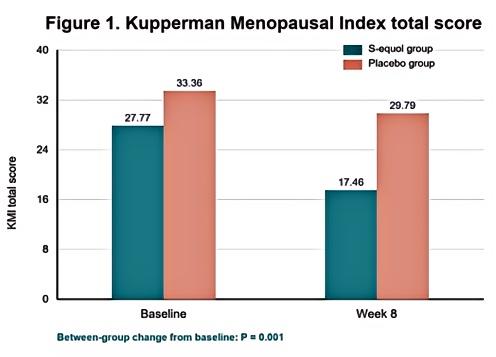
Kupperman Menopausal Index
Mean total score among completers
Between-group change from baseline: p = 0.001
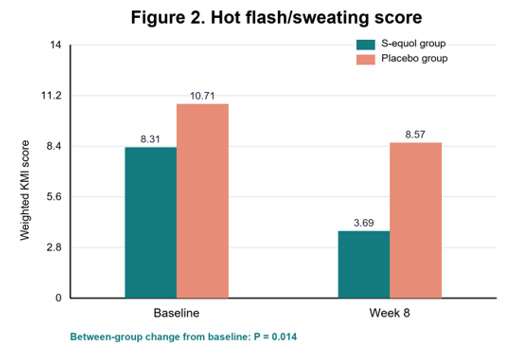
The publication reported greater reductions in total Kupperman Menopausal Index (KMI) and weighted hot flash/sweating scores in the S-equol group than in the placebo group. These are symptom-rating scores, not counts of daily hot flashes.
Scroll the table horizontally to compare all study groups.
| Measure | S-equol Baseline → week 8 | Placebo Baseline → week 8 | Between-group change |
|---|---|---|---|
| Total KMI score | 27.77 → 17.46 | 33.36 → 29.79 | p = 0.001 |
| Weighted hot flash / sweating score | 8.31 → 3.69 | 10.71 → 8.57 | p = 0.014 |
Mean values among completers. Between-group changes were evaluated using Welch’s t-test (total KMI) and the Mann–Whitney U test (weighted hot flash/sweating score).
View the original study figures
Data source: Zhang W, Li Y (2026), DOI 10.34297/AJBSR.2026.32.004130.
Sleep, skin and hair observations
Additional outcomes from the same 27 completers are shown below. Skin scores improve downward; hair scores improve upward. These are rating scales, not measured percentage changes in skin appearance or hair growth.
Scroll the table horizontally to compare all study groups.
| Measure | S-equol (n=13) | Placebo (n=14) | Nominal p |
|---|---|---|---|
| Weighted KMI insomnia | 3.69 → 0.92 | 4.43 → 4.14 | <0.001 |
| Skin total (SCRS) | 10.54 → 4.46 | 10.64 → 10.86 | <0.001 |
| Hair total (HCRS) | 7.77 → 9.31 | 7.14 → 7.43 | <0.001 |
| Mood fluctuation | 1.69 → 1.23 | 1.86 → 1.50 | 0.601 |
| Muscle pain | 1.31 → 0.69 | 1.79 → 1.50 | 0.096 |
Mood fluctuation and muscle pain did not differ significantly between groups. Secondary outcomes and subscales were not adjusted for multiple comparisons. All remain exploratory.
Source: Table 1 of the published paper. Values refer to between-group changes; see the paper for scales and methods.
Read the findings in context
This was a small exploratory study. The groups were not fully balanced at baseline, the analysis included completers rather than all randomized participants, and all three withdrawals were from the intervention group. Multiple comparisons were not adjusted.
These limitations mean the results are preliminary. Larger, preregistered confirmatory trials are needed before drawing broader conclusions about efficacy or long-term safety.
Publication and source
Zhang W, Li Y. American Journal of Biomedical Science & Research. 2026;32(1). Published 3 September 2026. DOI: 10.34297/AJBSR.2026.32.004130.
Read the full published paper